
Overworld Encounter Scripting Tools
What It Does

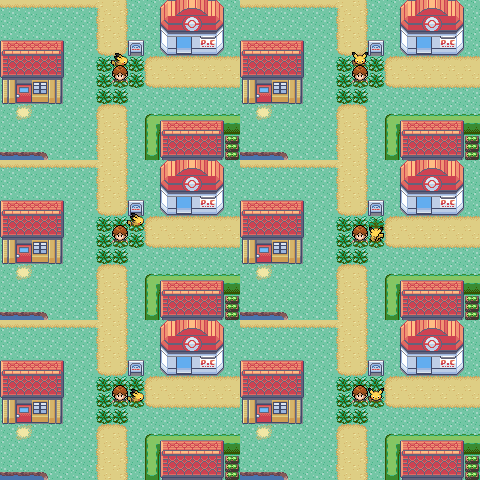
Three tools that make overworld wild Pokémon encounters usable in scripts and cutscenes, not just as ambient spawns. The tools were built in two commits, then improved by LordRainDance.
How It’s Implemented
GetOverworldMonSpecies reads the graphicsId of the last selected object event and returns a species ID. It covers every Pokémon object event in vanilla Emerald, and handles the expansion’s OBJ_EVENT_GFX_SPECIES() macro automatically as well. Shininess is also checked. The species and shiny status are written into VAR_0x8004 and VAR_0x8005 respectively.
startoverworldencounter is a macro that chains this function and others to start a battle. It calls GetOverworldMonSpecies, plays the returned species cry, creates the enemy party and triggers the wild battle. Originally the macro required a level argument, meaning every encounter in script needed its own level written in manually.
setobjectaswildencounter calls the script command ScrCmd_SetObjectAsWildEncounter that reads a localId and encounterType. This object must be a variable object event. It calculates whether the Pokémon should spawn, using the equation SPAWN_ODDS/65536, and either hides the object via flag or pulls from the map’s actual wild encounter table to pick a species. The encounter types that can be used are ENCOUNTER_FIXED, ENCOUNTER_LAND, ENCOUNTER_SURF, ENCOUNTER_ROCK_SMASH, ENCOUNTER_OLD_ROD, ENCOUNTER_GOOD_ROD, and ENCOUNTER_SUPER_ROD, pulling from the the relevant encounter tables. There is also a fallback table, in case the encounter header could not be used or if ENCOUNTER_FIXED is chosen. The species is packed into the object’s graphics ID variable, is how the it is later used again.
A Contributor Improvement
Later on, I received a PR from lordraindance2, which was genuinely amazing. It felt great to know that someone cared enough about my code to submit a very welcome inprovement. It refactored startoverworldencounter so levels are drawn automatically from the route’s encounter table data rather than requiring a manual argument. The getter functions (GetLocalLandMon, GetLocalWaterMon, GetLocalRockSmashMon, GetLocalFishingMon) were changed from returning just a species ID to returning a full WildPokemon struct with level included. A new GenerateOverworldWildMon() function was added to get encounter data by graphics ID.
Wander Movement Types
Two additional movement types restrict where object events can wander, making them behave more naturally as overworld wild Pokémon. MOVEMENT_TYPE_WANDER_IN_GRASS prevents an object from stepping onto any non-grass metatile, and MOVEMENT_TYPE_WANDER_IN_WATER does the same, but for surfable water. Both of these use the existing wander step functions in MovementType_WanderAround, with Step4 adjusted to check metatile behaviour.
MovementType_Wander_Step3 was consolidated in pokeemerald-expansion v1.9.2, so projects on earlier versions should use MovementType_WanderAround_Step3 instead.
Installation
This feature can be pulled by commits. The README.md of this branch can be used to add these changes. A full tutorial for the new movement types can be found on the Team Aqua’s Asset Repo wiki.
Why It’s In Ikigai
Pokémon Ikigai has scripted moments built around specific wild Pokémon, and these may contain encounters that can be shown better than just having the player step into grass. These tools make that possible without hardcoding species into battle setup scripts or writing specific workarounds for every encounter.